Steph Jordan (they/she)
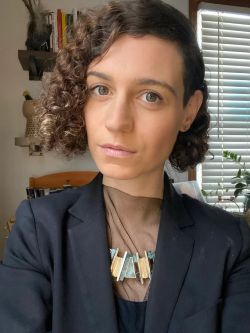
I am an ethnographer, organizer and tech developer dedicated to storytelling for environmental justice and tech advocacy.
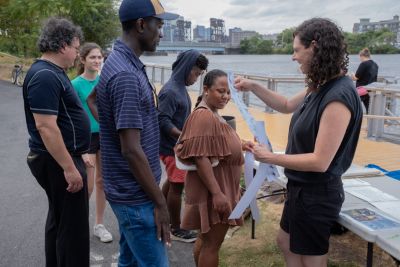
I am committed to representing the lived experience of those who are on-the-ground (or even underground) and to leveraging my work to resource communities and provide direct impact. I deeply value the authenticity and safety of the communities I work with and within. I am currently invested in a community-engaged art-science project on the Passaic River, documenting the art and stories of the residents around the superfund sites of this beautiful and toxic water. The ethnographic findings for this project — from interviews and observations in the river’s riparian zone since 2023 — inform a book series and set of large-scale artworks that are currently being installed on the Newark Riverfront in 2025.
For over a dozen years prior, my work has investigated engineering in the climate and ocean sciences with a focus on sustainability across two axes: technical (materials, maintenance, quality control, calibration) and human (labor, equity, resilience), and their co-construction. I work in direct collaboration with scientists to enact inclusive principles in the full pipeline of scientific work from problem identification, design, deployment and modeling through knowledge dissemination. I practice principles of co-design, community engagement and participatory methods. In doing so, I hold a deep commitment to intersectionality and anti-harassment in science & technology, and meaningfully interpreting data across industry, academic and public resources. My work operates at the intersection of environmental, design and social justice. The bodies of water where I live greatly inspire and inform my research and advocacy: I am indebted to the care and stewardship of the the Anishinaabe Three Fires Confederacy (for the stolen lands known as Ypsilanti, Michigan) and the Lenni-Lenape People of Lenapehoking and the Poutaxat (for the stolen lands now known as Philadelphia, Pennsylvania).
Often endeavors in big data in the earth sciences involve aspirations for a more equitable and accessible future through information and communication technologies. My work jointly expresses the importance of building sustainable infrastructure for the climate and ocean sciences and details the significant labor of its affiliates who grapple with vulnerabilities both social and material. These vulnerabilities often concern intersectional inequities of race, gender, ability and class. My research starts at the scientific realities that look somewhat like science fiction and asks: how do we work with and around technology to act with care for both ourselves and the planet? What kinds of futures and whose futures are we ushering in with the development of new scientific infrastructures? How do we build and maintain infrastructures of earthly care for generations? These questions have taken me into worlds involving the development of the largest U.S. ocean observatories, the passing of the Nuclear Test Ban Treaty and radioactive baby teeth in St. Louis, a convergence of space and ocean scientists searching for life and climate answers on the icy moons around Jupiter and Saturn and into the extreme conditions of remote sensing in polar and subpolar regions.
I achieved my BA from Rutgers University and my PhD from Cornell University. My dissertation, The Instrumented Ocean: How Sensors, Satellites and Seafloor-Walking Robots Changed What It Means to Study the Sea, traces the shifting conditions of labor and life that accompany an unprecedented large-scale long term big data infrastructure development project in the ocean sciences in the U.S.
In both artistic and academic outputs, my work contributes to and draws from a diversity of fields and subfields, particularly feminist technoscience and infrastructure studies, cyberinfrastructure and eScience, collaboration and computer-supported cooperative work (CSCW), human-computer interaction (HCI), queer studies, critical race studies, science & technology studies (STS), and science policy. I am very honored to be a founding board member of the Labor Tech Research Network and have provided professional service to multiple institutions including the National Science Foundation; NASA; the Society for the Social Studies of Science (4S); CHI, DIS and CSCW conferences; and Engineers Without Borders. At MSU, I contributed to and launched multiple efforts for Diversity, Equity and Inclusion (DEI) on campus and organized the Queerpocene Ecofeminist Research Group. For more information please click further in the menu bar above or see my CV or my LinkedIn profile.
I am available for ethnographic and user research consulting, information architecture and knowledge infrastructure contracts, hired talks and workshop organizing. If you are looking for mentorship, I am not longer affiliated with a university nor accepting PhD advisees but I am happy to help you achieve your goals. Please email me at stephaniebeth@pm.me for requests for collaboration.
Graduated Students
I have been extremely lucky to work closely with these brilliant innovative inspiring collaborators in my role as a professor of Information Science at Michigan State University:
- Caitlin Geier (Ph.D., Michigan State University Information and Media)
- Jhovonne Fernandez (M.A., Michigan State University Information and Media)
- Robyn Bria Adams (Ph.D., Michigan State University Information and Media)
- Janine Sakiko Slaker (Ph.D., Michigan State University Information and Media)
- Megan Louise Knittel (Ph.D., Michigan State University Information and Media)
- Sarah Kilbreath (M.A., Michigan State University Health & Risk Communication)
- Johna Winters (MS, Oregon State University Marine Resource Management)
- Chris Fennell (Ph.D., Michigan State University Information and Media)
- Kaleigh Wiseley (M.A., Michigan State University Information and Media)
- Ziyuan Zhang (M.A., Michigan State University Information and Media)
- Jiangshan Xi (M.A., Michigan State University Information and Media)
Courses Taught at Michigan State University:
- MI101: Understanding Media & Information
- JRN916: Qualitative Methods
- MI239: Digital Footprints: Cybersecurity and Privacy
- MI350: Evaluating HCT: Usability and User Research
- MI401/LBC491 Cyborgs and AI
- MI401: Information and Society
Banner image description: sunset over the ocean with a large round anchor in the foreground.
 Stephanie Beth Jordan
You must be logged in to post a comment.